
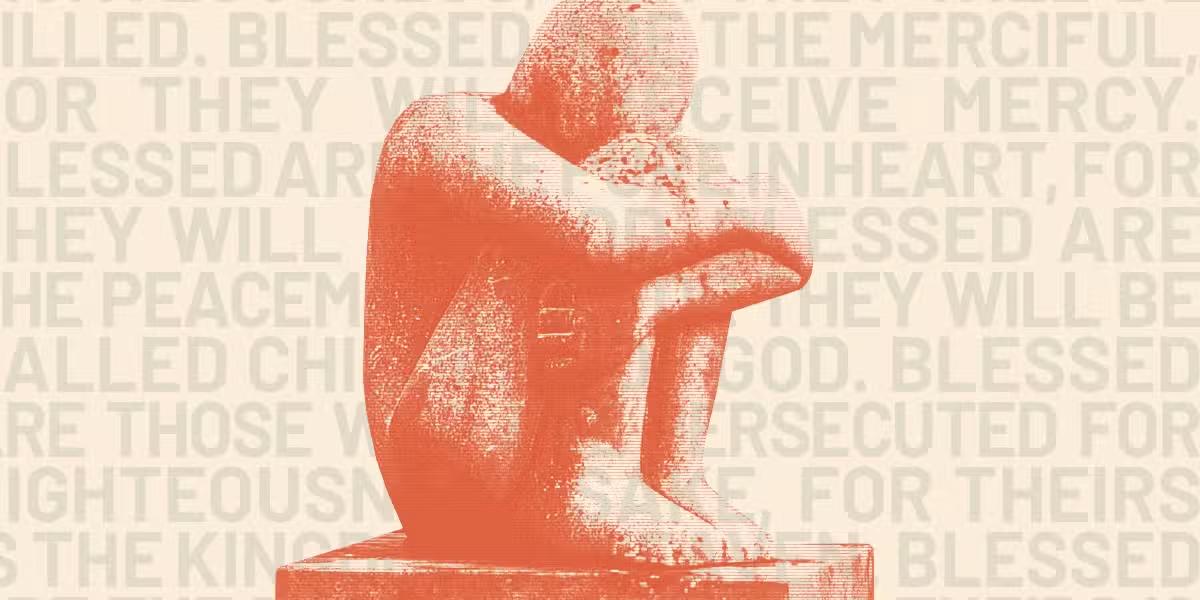
This friar points to three ways we can better understand and live the joy of the beatitudes in our everyday lives.
Do you feel that your life is blessed? Maybe a better question is: What does it mean to have a blessed life?
I often see the word blessed in social media hashtags and photo descriptions. “Just got a promotion, so blessed!” or “Cancer-free, feeling blessed!” For many people, blessing is synonymous with good fortune and that God is the reason for our happiness. On one level, it’s wonderful to see people with thankful hearts giving credit to God. On another level, it’s a bit unsettling to see Jesus’ words so ignored.
In the Gospels of Matthew and Luke, Jesus offers the beatitudes (literally, “the blessings”), and they couldn’t be further from our modern usage of the word. Rather than list desirable states of happiness, Jesus says that those who are truly blessed are the poor, those who mourn, the meek, those who hunger and thirst, the merciful, the pure of heart, the peacemakers, and even those who are persecuted. Not exactly a life that many desire, is it? I can hardly think of a time when I saw someone on social media using the hashtag “blessed” when getting evicted, learning of a terminal illness, or being made fun of.
How do we make sense of Jesus’ words then? What is the point of this sort of suffering? For me, there is only one satisfactory answer: Our experiences of affliction are meaningful in themselves, not only because they lead us to greater union with God in the future but also because they offer us joy in the present moment as we experience a taste of the kingdom of heaven and our salvation is brought to fulfillment.
As Christians, we do not simply endure these conditions to receive something later; these conditions offer us the very grace of God that makes our lives blessed in the here and now. I believe that this can be seen in three ways: greater dependence on God, empathy for others, and focus on what matters most.
Dependence on God
The 1992 United States men’s Olympic basketball team was something to behold—Michael Jordan, Magic Johnson, Karl Malone, Patrick Ewing, Scottie Pippen, John Stockton, Larry Bird, and so on. On the world’s greatest stage against the best competition possible, they won each game by an average of 44 points and won the gold medal game—a game played against the second-best team in the world—by 32 points. The US team was incredible and rightly deserved to be called the “Dream Team.”
Do you remember who the coach was? Probably not. For the record, it was Chuck Daly, but really, who cares who the coach of that team was? When you have a team like that, including Michael Jordan, the coach is not getting much credit. My guess is that anyone reading this could have coached that team and it still would have won the gold because it was the players that made the difference. But what if that coach had taken five people no one had ever heard of and won the gold medal? Had he stood against all odds and achieved something miraculous, people would be lining up around the corner to have this man coach their kids.
This is what God wants. He wants to be seen as the miracle worker, the one who created everything in existence and holds everything in the palm of his hand. He wants to be relied on more than anything else and receive all the credit for being God.
When we seemingly have all we need—high-paying job, comfortable house, supportive friends—it can be easy to believe that we’re successful because of our own actions. If we’re the authors of our own destiny, what is the need for prayer? What is the need for giving thanks? What is the need for God? How foolish we are in those moments.
Conversely, it is in times of great need—when we’ve lost our job, when we’re short on rent, when we find ourselves abandoned and alone—that we realize how little control we actually have in life and how much we rely on God’s help. While poverty is by no means a guarantee for faith, there is no doubt that it can flourish among the materially poor; they have faith, not despite their poverty, but precisely because of it. There’s no greater blessing than being content with what you have and living without worry because you know that God will always provide.
I’d invite you to pause for a moment and ask yourself: Do you pray as if your life depends on it? In other words, is your prayer fueled by desperation and outright dependence on God? The world considers an independent, comfortable life to be a blessing, but it doesn’t compare to the ultimate blessing of surrendering completely to God and trusting that he will take care of it all.
Empathy
When I was in high school, my faith wasn’t strong. I believed, but I didn’t really understand. A major breakthrough came for me sitting in adoration my freshman year, somewhat distracted, thinking about my girlfriend. I thought about how much I loved her, how I would do anything for her no matter what happened, and how amazingly reassuring it felt to know that this feeling was reciprocated. Then it clicked. This is how God feels about me.
No matter what I do or what I need, God will always be there for me, wanting nothing more than for me to be around. It was my experience of vulnerability and self-sacrifice with this girl that helped me feel the presence of God in my life.
And then two days later she abruptly broke up with me. Plot twist! I share this story simply to say that I know what it’s like to have your heart pierced and to feel like your world is crashing down around you. When I encounter a student who has just gone through a breakup, I will not for a second think to say, “Well, another one will come along,” or “Oh, you’ll get over it.” More than some intellectual exercise, I can feel what they feel.
When I ask myself why Jesus considers afflictions like mourning and persecution to be signs of blessing, I always turn to the line attributed to St. Oscar Romero: “There are certain things in life that can only be seen through eyes that have cried.” While I think any person of goodwill can intellectually understand another’s pain, there is something to actually experiencing pain yourself that opens your eyes to the pain of others around you. You don’t just see with your eyes; you feel with your heart.

And in doing so, do we not grow closer with one another? When you are able to mourn with others and feel their pain, it’s nearly impossible to remain detached. Our common experience binds us. It creates a brotherhood and sisterhood of concern, the recognition that we are not random ships passing in the night but people with a deep connection, responsible for others’ well-being.
While I would never advocate for more tragedy in our lives, I think we could all use a little more heartbreak, particularly over our enemies. So often we are fueled by resentment and indignation toward those who cause pain and division in this world. But what if we could recognize our “enemies” as both perpetrators and victims? What if we could see them as wounded individuals, trapped in the cycles of sin and pain, causing harm because that’s what they’ve received? Imagine how different our world would be if we were able to feel empathy and even a sense of communion and mutual responsibility toward those who do evil.
This is the way Jesus acted, and it is what we must imitate. On the cross, he spoke of the people that condemned and crucified him, “Father, forgive them, they know not what they do.” His heart was not filled with rage; it broke for them. He loved them because he understood what they had been through.
I’d invite you to pause again and ask yourself: Have you ever experienced tragedy that ended up helping you love others more? In other words, has a moment of personal pain opened your eyes to the pain of others in a way that you can never see them the same way again? The world considers happiness and bliss to be a blessing, but it doesn’t compare to the ultimate blessing of developing a deep sense of love and responsibility for the body of Christ, including even our enemies.
Focus
A few years ago, I worked at a refugee camp in Mexico where men and women could get a meal, medical attention, and a place to sleep for the night. One day, I met a man who was on this 1,000-mile trek for the third time. He told me what he had been through, the dangers of extortion and violence, and how he feared for his life as he traveled through Mexico on his way to Texas.
In my ignorance, I asked him why he did it. The danger didn’t seem something worth risking. He simply responded, “What choice do I have?” It turns out that, as a child, this man had been brought to the United States, where he lived for 20 years. He had a wife and two young girls waiting for him. When he asked, “What choice do I have?” he meant that he would rather die than not do everything he could to return to them. It’s what he desired more than anything else, what made life worth living, and what he was willing to die for to achieve.
This is the sort of hunger that Jesus desires. This is the sort of single-minded devotion, pure motivation, and focused attitude that the kingdom requires. The Gospel is not something we do in our spare time or something we give up on when the going gets tough. It’s the sort of thing we’d rather die for than abandon.
As strange as it sounds, I don’t believe our world has much desire left in it. Despite its insatiable appetite for creature comforts, giving in to seemingly every impulse of the day, I don’t believe the world knows much about actual desire. I’m talking about the desire that fuels us to a future goal, focuses our attention away from temptations and distractions, and remains steadfast when things get difficult. In other words, it’s the ability to want something so much that you’re willing to make any sacrifice to achieve it.
When Jesus speaks of being hungry, having a pure heart, and the willingness to endure persecution, this is what he’s referring to. Not that he wants us to suffer, but that he wants our desire for the Gospel to be so great that we are willing and able to endure suffering in this world. He wants people who are so focused on him and the joy of the kingdom he offers that riches, acclaim, comfort, and earthly happiness are not tempting in the least.
They’re distractions, immediate gratifications that do not last. Because Christians desire what cannot be fulfilled by this world, going without the pleasures of this world does not bother us one bit.
I’d invite you to pause one last time and ask yourself: What do you desire so much that you are willing to give up absolutely everything to obtain it, even your life? The world considers remaining on this earth for as long as possible in order to obtain as much as possible the mark of blessing, but it doesn’t compare to the ultimate blessing of living every moment with eyes fixed on the kingdom, knowing where we’re going and how we’re going to get there.
The Beatitudes: Celebrating the Blessing
So, what does it mean to be blessed? For our world, it means being comfortable in the here and now, having what we want without much difficulty or pain. It’s enjoyable, and I have no doubt that God wants us to taste the fruits of goodness from time to time.
The problem, as the beatitudes point out, is not so much in the comforts themselves, but in what they do to us. When we are comfortable by earthly standards, it is all too easy to remain comfortable with the standard of earth. We like this world and we do not want to leave it, which means defending what we have, seeing others as threats to our comfort, and taking any means necessary to maintain it. Talk about gaining the whole world and losing your soul.
As Christians, the beauty of the beatitudes is that they remind us that this world is not our home. What we have in this life does not define our worth, nor does it represent anything that is lasting. The reason that Jesus says that those who are truly blessed are those who suffer (poverty, mourning, and the like) is not because he wants us to suffer; it’s because he wants us to realize that nothing in this world can ever fully satisfy.
Only he can. And so, even though suffering may appear at first to be without benefit, if it helps us depend more on God, grow in empathy, and focus us on what really matters, how can it be anything but a blessing?

Beatitudes Beatitudes Beatitudes Beatitudes Beatitudes Beatitudes Beatitudes Beatitudes Beatitudes Beatitudes Beatitudes Beatitudes Beatitudes Beatitudes Beatitudes Beatitudes Beatitudes Beatitudes
6 thoughts on “Acting on the Beatitudes ”
It is not right that I am discriminated against because of my age. I would like to join the Franciscans orders of Brothers, but I’m told that I am too old. This is not right.
Every organization has to have rules in order to exist. You can still be a Franciscan and not be in an order. Join in their way of life and you will find happiness. Let God use you right where you are. You are loved beyond your understanding. ♥️🙏📿
I am a professed member of the Secular Franciscan Order, the order that St. Francis of Assisi founded for lay people. We live in our own homes, but we belong to a local fraternity & meet monthly for communal prayer, teaching, business & social fellowship. Some members are married. Some, like myself, are single. I was professed at age 39 & I am now 72. In our fraternity we have had elderly people begin formation & be professed. One member joined our fraternity in her 90s & was professed shortly before she died.
Our formation period consists of being inquirers for a few months, attending meetings to decide if we wish to pursue formation. Then there is a 6 month period of classes, usually once a month in addition to participating in our regular monthly fraternity meetings, leading up to investiture. Finally there is a period of about 18 months of classes from investiture to continue discernment & learning about St. Francis, the Gospel life & living in the Church according to the example & spirit of St. Francis (poverty, chastity, obedience, prayer, the Eucharist, devotion to Our Lady, being troubadours for the LORD) in the secular world in the secular state of life leading to profession, which is a promise & firm permanent commitment to live the GOSPEL in the spirit of St. Francis in our secular state of life.
I know it’s not the same as being a consecrated religious living in community with stricter vows, but it is still a commitment to living the GOSPEL in the footsteps of St. Francis of Assisi & it is becoming a member of the Franciscan family.
A long time ago an elderly man from my parish came into the sacristy & asked a Franciscan priest who was helping out in our parish & preparing to preside at Mass if it would be possible for him to join the order. I thought the priest was too blunt & rather rude & not very Franciscan when he responded “At your age all we could do for you is bury you!” Fortunately, as the LORD would have it, I was already a Secular Franciscan & I was in the sacristy preparing to serve as lector & I told him that I am a Secular Franciscan & perhaps GOD was calling him to become a Secular Franciscan. He came to our fraternity, entered formation, & became a professed Secular Franciscan in our fraternity. I sometimes drove him home from our fraternity meetings. He is now deceased but he was part of our fraternity for a few years.
Perhaps GOD is calling you to become a Secular Franciscan, the order that St. Francis of Assisi founded for lay people.
It’s not the same as being a consecrated religious living together under strict rules, but it involves a formation process leading to profession, which is a permanent commitment to live the GOSPEL in the spirit & footsteps of St. Francis of Assisi as a lay person, whether married or single, in the secular world in our secular state of life. We have a rule. We live in our own homes but belong to a local fraternity & meet regularly (usually once a month) for communal prayer, teaching, business, & social fellowship. There is a formation process of an approximate total of a little over 2 years involving classes about once a month learning about St. Francis of Assisi, the Gospel, prayer, becoming a “troubadour for the LORD”, the Church, the Eucharist, devotion to Our Lady, poverty, chastity, obedience as applied to living our vocation as a lay person in the world, etc., in addition to participating in our monthly fraternity meetings.
In our fraternity we have no maximum age limit. I was professed at age 39 & I am now 72. One member entered formation in her 90s & was professed shortly before she died.
Many years ago an elderly man who was a member of my parish entered our sacristy & asked a Franciscan priest who was helping out at our parish & preparing to preside at Mass if he could join the Franciscan Order. I thought this priest was too blunt, somewhat rude & “not very Franciscan” when he responded “At your age, all we could do for you is bury you!” Fortunately, as the LORD would have it, I was already a Secular Franciscan & I was in the sacristy preparing to serve as lector. So I told him thar I am a Secular Franciscan & perhaps GOD was calling him to become a Secular Franciscan & I invited him to come to our fraternity meeting. He came, he joined our fraternity, began formation & was professed. He was a professed member of our fraternity & sometimes I drove him home from our fraternity meetings. He passed away several years ago, but he definitely was a professed member of our Secular Franciscan fraternity for a number of years.
We are definitely members of the Franciscan family & the local fraternity is a kind of family joined in love & prayer & shared common values. I have been blessed beyond measure & in ways beyond what I could imagine in becoming a Secular Franciscan.
Perhaps GOD is calling you to become a Secular Franciscan, the order that St. Francis of Assisi founded for lay people.
It’s not the same as being a consecrated religious living together under strict rules, but it involves a formation process leading to profession, which is a permanent commitment to live the GOSPEL in the spirit & footsteps of St. Francis of Assisi as a lay person, whether married or single, in the secular world in our secular state of life. We have a rule. We live in our own homes but belong to a local fraternity & meet regularly (usually once a month) for communal prayer, teaching, business, & social fellowship. There is a formation process of an approximate total of a little over 2 years involving classes about once a month learning about St. Francis of Assisi, the Gospel, prayer, becoming a “troubadour for the LORD”, the Church, the Eucharist, devotion to Our Lady, poverty, chastity, obedience as applied to living our vocation as a lay person in the world, etc., in addition to participating in our monthly fraternity meetings.
In our fraternity we have no maximum age limit. I was professed at age 39 & I am now 72. One member entered formation in her 90s & was professed shortly before she died.
Many years ago an elderly man who was a member of my parish entered our sacristy & asked a Franciscan priest who was helping out at our parish & preparing to preside at Mass if he could join the Franciscan Order. I thought this priest was too blunt, somewhat rude & “not very Franciscan” when he responded “At your age, all we could do for you is bury you!” Fortunately, as the LORD would have it, I was already a Secular Franciscan & I was in the sacristy preparing to serve as lector. So I told him thar I am a Secular Franciscan & perhaps GOD was calling him to become a Secular Franciscan & I invited him to come to our fraternity meeting. He came, he joined our fraternity, began formation & was professed. He was a professed member of our fraternity & sometimes I drove him home from our fraternity meetings. He passed away several years ago, but he definitely was a professed member of our Secular Franciscan fraternity for a number of years.
We are definitely members of the Franciscan family & the local fraternity is a kind of family joined in love & prayer & shared common values. I have been blessed beyond measure & in ways beyond what I could imagine in becoming a Secular Franciscan.
I am a professed member of the Secular Franciscan Order, the order that St. Francis of Assisi founded for lay people. We live in our own homes, but we belong to a local fraternity & meet monthly for communal prayer, teaching, business & social fellowship. Some members are married. Some, like myself, are single. I was professed at age 39 & I am now 72. In our fraternity we have had elderly people begin formation & be professed. One member joined our fraternity in her 90s & was professed shortly before she died.
Our formation period consists of being inquirers for a few months, attending meetings to decide if we wish to pursue formation. Then there is a 6 month period of classes, usually once a month in addition to participating in our regular monthly fraternity meetings, leading up to investiture. Finally there is a period of about 18 months of classes from investiture to continue discernment & learning about St. Francis, the Gospel life & living in the Church according to the example & spirit of St. Francis (poverty, chastity, obedience, prayer, the Eucharist, devotion to Our Lady, being troubadours for the LORD) in the secular world in the secular state of life leading to profession, which is a promise & firm permanent commitment to live the GOSPEL in the spirit of St. Francis in our secular state of life.
I know it’s not the same as being a consecrated religious living in community with stricter vows, but it is still a commitment to living the GOSPEL in the footsteps of St. Francis of Assisi & it is becoming a member of the Franciscan family.
A long time ago an elderly man from my parish came into the sacristy & asked a Franciscan priest who was helping out in our parish & preparing to preside at Mass if it would be possible for him to join the order. I thought the priest was too blunt & rather rude & not very Franciscan when he responded “At your age all we could do for you is bury you!” Fortunately, as the LORD would have it, I was already a Secular Franciscan & I was in the sacristy preparing to serve as lector & I told him that I am a Secular Franciscan & perhaps GOD was calling him to become a Secular Franciscan. He came to our fraternity, entered formation, & became a professed Secular Franciscan in our fraternity. I sometimes drove him home from our fraternity meetings. He is now deceased but he was part of our fraternity for a few years.