
The peace that St. Francis of Assisi showed with birds, wolves, lambs, larks, and worms reminded his contemporaries that Adam and Eve lived in total harmony with all creatures before they were sent from the Garden of Eden. The serpent in the Garden of Eden promised Eve and Adam knowledge and power that would equal God’s, but the serpent’s promise was worthless.
Women and men suffering from leprosy were perhaps the most universally despised social group in Francis’ day. The Lord led Francis to recognize them as his brothers and sisters. His respect for them as equals in God’s creation brought peace to these afflicted ones.
Peace is both a wonderful and a much-abused word. Because we seek peace constantly, it has many counterfeits. For example, peace at any price always yields no peace at a very steep price.
Francis promoted peace among his friars, among the Poor Clares, among the Secular Franciscans, among all people. Thomas of Celano writes that the immensely popular Francis “seemed to be a man of another world” (First Life, 36). Francis called people back into the peace and harmony of a world into which God had created the human family and which was as fragile in Francis’ day as it is in our own.
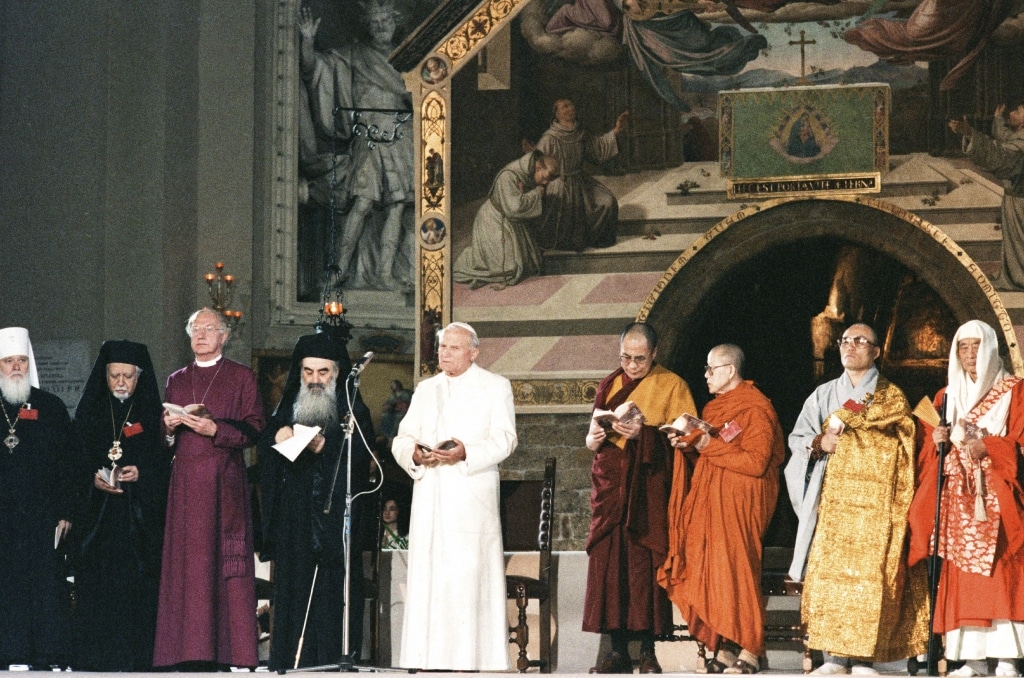
Peace is a gift from God. Human actions that cooperate with God’s grace promote peace in the world. On October 27, 1986, St. John Paul II invited leaders of world religions to Assisi to pray and fast there for the sake of world peace. At the concluding prayer service, the pope called those present and everyone who would hear or read his words to be “artisans of peace.” Francis of Assisi was certainly an artisan of peace.
Earlier, the same pope had designated Francis as the patron of ecology. Francis learned to appreciate God’s gift of natural resources, not to dominate them selfishly. All creation pointed Francis toward God. He would have agreed with Dante Alighieri, who wrote in the Divine Comedy that over the gate of heaven is the affirmation, “In his will is our peace.”
“Peace be with you” echoed from Jesus’ life through the life of St. Francis of Assisi. We are called to allow it to reverberate through our lives as well.
The following six reflections on peace are inspired by quotes from St. Francis or his first biography, by Thomas of Celano. The article concludes with several suggested peacemaking activities.
Justice Seeks Peace
“The friars should be delighted to follow the lowliness and poverty of our Lord Jesus Christ, remembering that of the whole world we must own nothing; but having food and sufficient clothing, with these let us be content (1 Tm 6:8), as St. Paul says. They should be glad to live among social outcasts, among the poor and helpless, the sick and the lepers, and those who beg by the wayside.
If they [the friars] are in want, they should not be ashamed to beg alms, remembering that our Lord Jesus Christ, the Son of the living, all-powerful God set his face like a very hard rock (Is 50:7) and was not ashamed. He was poor and he had no home of his own and he lived on alms, he and the Blessed Virgin and his disciples” (Rule of 1221, chapter 9).
January 1 is a day of prayer for world peace. Peace is a work of justice; it does not come about by a display of superior strength or military might. In fact, it can be argued that those who “live among social outcasts, among the poor and helpless, the sick and the lepers, and those who beg by the wayside” most truly effect the cause of peace and justice by changing society at its very roots: its people.
Peaceful Thinking
“Blessed are the peacemakers, for they shall be called the children of God (Mt 5:9). They are truly peacemakers who are able to preserve their peace of mind and heart for love of our Lord Jesus Christ, despite all that they suffer in this world” (Admonition XV).
It is very easy to engage in “if only” thinking: If only I had been born into a wealthier family, if only I had the advantage of a better education, if only I knew more influential people who could advance my career, and so on. “If only” thinking suggests that I am a spectator of my life, not an active participant in it.
Someone who constantly engages in “if only” thinking can never truly be at peace. She or he imagines that the key to happiness lies in someone else’s hands, someone who is withholding that key. Jesus’ words will often seem an obstacle because the “if only” thinkers tend to forget that Jesus suffered and died on a cross. If Jesus had followed their example, his time on the cross would have been filled with complaints about his bad luck. The Gospels, especially the Gospel of John, show Jesus as very deliberate in his choices. He rules—even from the cross.
The Next Step
“Every creature in heaven and on earth and in the depths of the sea should give God praise and glory and honor and blessing (Rv 5:13); he has borne so much for us and has done and will do so much good to us; he is our power and our strength, and he alone is good (see Lk 18:19), he alone most high, he alone all-powerful, wonderful, and glorious; he alone is holy and worthy of all praise and blessing for endless ages and ages. Amen” (Letter to the Faithful).
We praise God because that is the only way that we can live truthfully. We are not the sources of all goodness, every blessing. God is. Whatever strength we possess comes not from our efforts alone but from cooperating with God’s grace and direction in our lives. Francis wrote to his friars that once he embraced a leper, what had previously seemed bitter then seemed sweet. God’s ways always challenge conventional wisdom.
Choose Peace
“In all his preaching, before he proposed the word of God to those gathered about, he first prayed for peace for them, saying: ‘The Lord give you peace.’ He always most devoutly announced peace to men and women, to all he met and overtook. For this reason, many who had hated peace and had hated also salvation embraced peace, through the cooperation of the Lord, with all their heart and were made children of peace and seekers after eternal salvation” (1 Celano 23).
Francis of Assisi was one of the world’s greatest peacemakers. He started by recognizing that peace is never simply a human achievement; it always depends on God as its source. God will not impose peace on us but will always encourage us to choose the ways of peace. That’s a key part of our being made in the image and likeness of God.
Adam and Eve thought that they had a better plan. After all, wouldn’t disobeying God’s command turn them into God’s equals? There is a reason why Satan has long been called “the father of lies.” Genuine peace is never to his advantage. Peace always benefits us.
Sacrifice for the Kingdom
“Men ran, and women, too, ran, clerics hurried, and religious hastened that they might see and hear the holy man of God who seemed to all to be a man of another world. Every age and every sex hurried to see the wonderful things that the Lord was newly working in the world through his servant. It seemed at that time, whether because of the presence of St. Francis or through his reputation, that a new light had been sent from heaven upon this earth, shattering the widespread darkness that had so filled almost the whole region that hardly anyone knew where to go.
For so profound was the forgetfulness of God and the sleep of neglect of his commandments oppressing almost everyone that they could hardly be aroused even a little from their old and deeply rooted sins” (1 Celano 36).
Francis could have been reduced to a carnival attraction—interesting but hardly life-changing. What Celano describes here is a life-changing Francis—not by the force of Francis’ personality but by God’s grace. All levels of society recognized him as authentic. In a way, Francis was indeed a “man of another world” because he took the kingdom of God very seriously; it was a matter of life or death for him.
Free Living
“Truly Francis had a free and noble heart. Those who have experienced his magnanimity know how free, how liberal he was in all things; how confident and fearless he was in all things; with what great virtue, with what great fervor he trampled underfoot all worldly things. What indeed shall I say of the other parts of the world, where, by means of his clothing, diseases depart, illnesses leave, and crowds of both sexes are delivered from their troubles by merely invoking his name?” (1 Celano 120).
Francis was a paradox in his own day. In many ways, he might not have seemed a very free person. His health was never terribly strong. The friars could take up a great deal of his time, and not all of them were saints!
And yet Francis was one of the freest people who ever lived. He had no front to put up, no masks behind which to hide, no image to maintain except that of a sinner open to the grace of God. Celano and other early biographers emphasize that Francis appealed to men and women of all economic and social classes. Most people felt extremely at ease in his presence. The only ones who did not were men and women who wanted him to endorse their self-deceptions about where they stood before God and in relation to others.
Building Peace
In Assisi on October 27, 1986, Pope John Paul II urged those gathered to pray for world peace to become “artisans of peace.”
Francis of Assisi can help us to do that. Every such artisan is regularly acting for justice to improve life for everyone. That requires courage. “If only” thinking is an obstacle to peacemaking because it makes us observers instead of artisans. Peacemakers play the hand that has been dealt to them, respecting everyone else in the process.
Often we are on the cusp of deeper conversion but are reluctant to take the next step because we fear that it will be too costly, that other people may consider us foolish. After prayerful reflection, take whatever step you think God wants you to take next.
At times, people are embarrassed to be called a “peacemaker” because the person using that term may follow up with the suggestion that we are naive or idealists unprepared to live in the real world. Peacemakers act even if they know they may be criticized for doing so.
People frequently have to sacrifice an idea, behavior, or prejudice in order to create more room for God’s kingdom to grow within them.
Sacrifice at least one idea, behavior, or prejudice for the kingdom to grow in you. Peacemaking requires inner freedom and considerable creativity. Francis demonstrated both to a high degree. Ask yourself, “Am I enjoying the freedom that God wants me to have?” If you answer no, what needs to change for you to become an “artisan of peace”?
Living as Francis Did
Peace is a work of justice; it does not come about by a display of superior strength or military might. In fact, it can be argued that those who “live among social outcasts, among the poor and helpless, the sick and the lepers, and those who beg by the wayside” most truly effect the cause of peace and justice by changing society at its very roots: its people.
