
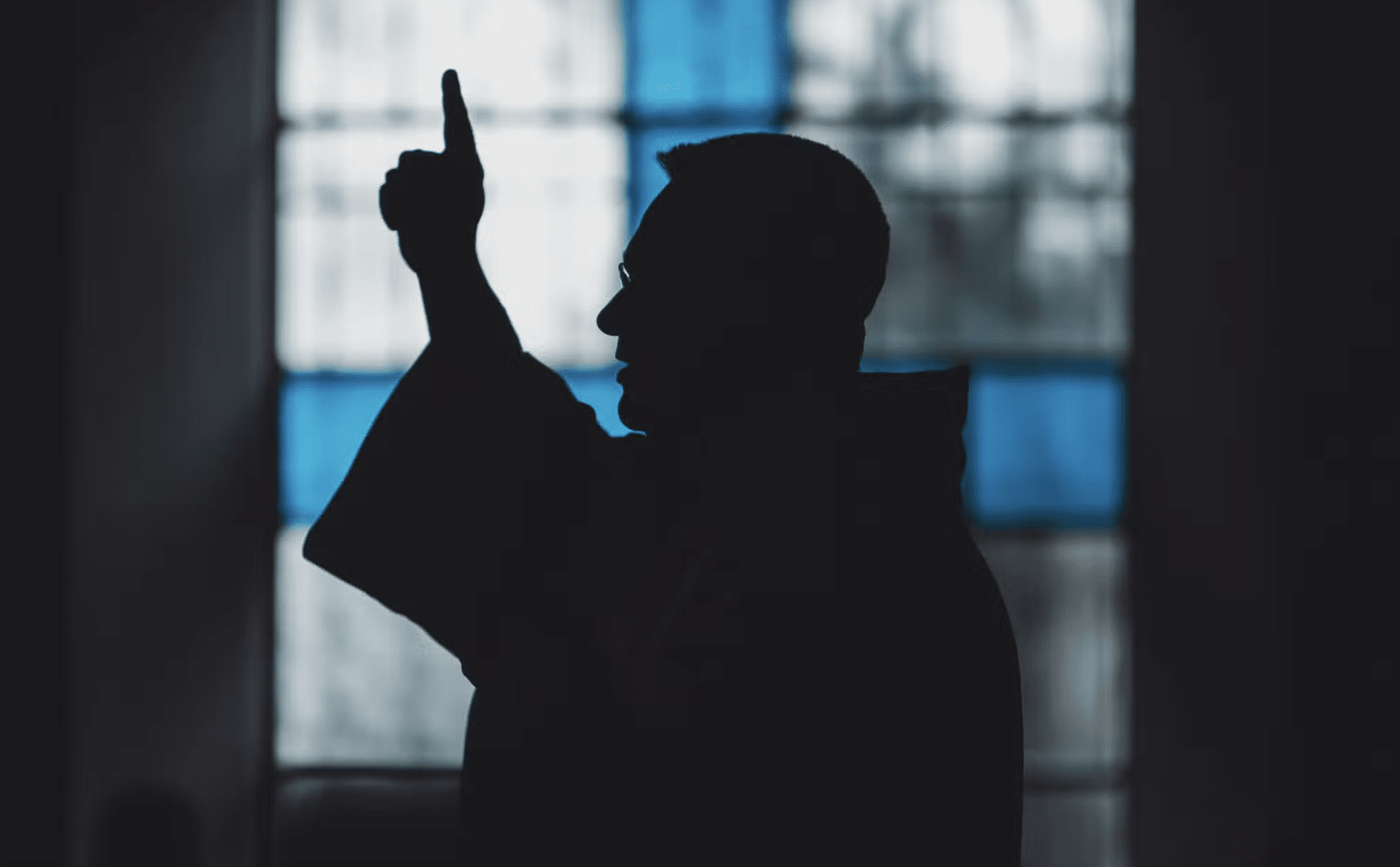
“How many of you own a pair of oxen? Raise your hand.”
With that opening, I was eager to hear where Fr. Tom DiFalco would take us by the end of his homily on a passage from Matthew’s gospel: “Take my yoke upon you…and you will find rest for yourselves. For my yoke is easy, and my burden light.”
The impact a priest makes with a homily is one of the criteria my husband and I rely on to decide which weekend Mass to attend at one of three parishes in our Cincinnati Archdiocese Family.
Putting aside my biases, eager to learn how others describe a “good homily,” I turned to my friend Michelle Arnold, a member of Corpus Christi Parish in the Blessed Trinity Family.
Besides being on pastoral council and volunteering as a lector and Eucharistic minister, she holds a Master’s degree in Religious and Pastoral Studies. Those credentials proved valuable when a deacon assigned to her parish asked Michelle and a few others for feedback after each of his Sunday homilies as he prepared for ordination.
For Michelle, an effective homily “must start with a good message, a story that connects to the scriptures of the day.” She sees the homily as “a bridge between the Liturgy of the Word and the Eucharist.”
Some homilies “pull on your heart,” while others “fire up your brain.” And sometimes they are humorous. In any case, she says, it’s all about “relationship, connection” between the homilist and the people in the pews. She is eager to talk about a favorite homilist, Fr. Don West, a parochial vicar for her family of parishes and a frequent celebrant at Corpus Christi.
“Fr. Don is very well received,” she says. “People feel as if they get something from his preaching. They feel connected to him.”
She especially appreciates that he “breaks the Word open in a way that is so human that his homilies help me understand the scriptures in a full way.”
Preparing the Homily
Following my conversation with Michelle, I met with Fr. Don to understand how he prepares homilies and what effect he hopes his words will have on the people hearing them.
A priest for 36 years and former pastor of three parishes in the Cincinnati area, he described his seminary classes that focused on writing and preaching homilies, and praised several older priests who mentored him as he matured as a homilist.
One priest in particular helped him gain a deeper understanding of the Bible. All three modeled how to talk with people. “They were not condescending; they were pastoral,” he remembers.
One of the greatest influences on him as a homilist was not a Catholic priest but a Lutheran minister who taught at the archdiocesan seminary. Fr. Don learned a lot from the two sections of a course the pastor taught, homiletics. That word sent me to the dictionary for a definition (“the art of preaching”). A scroll down the pages of dictionary.com led me to the word’s etymology, or root. Homiletics comes from the Greek word “to converse.”
Conversations are essential for what Fr. Don works to create as he begins each Tuesday to prepare weekend homilies. He reads and re-reads the three scripture passages and prays about how they fit together. Usually there’s a clear connection between Reading I and the Gospel, but Reading II, often one of the letters of Paul, sometimes feels like an outlier to him.
Then Fr. Don turns to favorite sources to look for stories to engage his listeners, as Fr. DiFalco did with his question about oxen. From Fr. Don’s seminary homiletics professor, he still remembers this figurative challenge: “You have to get them on the porch to get them into the house.”
Besides Tuesday’s preparation for his homilies, Fr. Don takes time before each Mass to sit quietly with a few notes he’s made from the homily he had written out earlier in the week. Some people at a previous parish, he says, “complained that I wouldn’t engage with him before processing into Mass.”
“I have to take time to get the right attitude, to get into a zone,” he says. “I can’t preach without inspiration, so my prayer right before Mass is ‘Holy Spirit, you are welcome here.’”
Hopes of a Homilist
What impact does Fr. Don hope to have on his listeners? He answers that question by sharing a sentence that for 20 years has ended his homilies, acknowledging that the opening clause is a quote from St. Augustine of Hippo:
“Let us become more of what we receive, so that we can continue to find ways to be Christ for one another.”
As I reflect back on Fr. Tom’s question about the oxen and the homily that flowed from it, I recall being inspired to ask myself how I could better help shoulder the burdens of family and friends.
After posing the oxen question to us, Fr. Tom told us that years ago he puzzled over how he could get grade school students at his weekly school Mass to understand why Jesus would use a yoke as a metaphor.
A few days before the school Mass, he took a trip to a nearby working farm and outdoor education center, hoping to find a prop. And there it was –a yoke—hanging above one of the doors. He borrowed that yoke, and during Mass asked two strong eighth-grade boys to carry it up to him.
(As he continued the story, I smiled: “Delightful, a bonus. A homily within a homily.”) He asked students if they had ever seen how skittish horses are when they are about to be saddled for the first time. He explained the same is true for young oxen when they initially encounter the two-ox yoke.
“So, the farmer takes an older, experienced ox and fits the yoke on, letting the younger animal check it out,” he explained. “When the younger one is also yoked, it is the older one who shoulders most of the burden.”
And that, he reminded the students, is exactly what Jesus does for us when we have a burden we are carrying. And it’s what we do for others as we try to imitate Jesus in our encounters with them. Appreciating the power of Fr. Tom’s and Fr. Don’s homilies, I sat in Mass this past Sunday waiting for the homily of our newly-ordained celebrant.
Aware of The FEMA Waffle House Index for measuring storm severity (full menu, limited menu, restaurant closed), I imagined an Arnold/West Homily Index (uninspiring, fair to middling, inspiring). On the basis 0f the A/W index, 0ur new priest ranked high on several fronts: opening with a story that got me “on the porch,” conversing with us, and breaking open the Word so we “could find ways to be Christ for one another.”
Driving home from Mass, I sought one more confirmation of my homily rating. I turned to my husband with my summary judgment: “He did fine.”
He nodded with an affirming “Yes.”

2 thoughts on “Discovering the Art of the Homily”
What a lovely essay! Sharing this with my parish community. Pax 🙏
I think the best talks, whether in church, at school, or anywhere else, have something in common. They make complicated ideas easy to understand through simple stories.
I really liked the example with the oxen and the yoke. It’s the kind of story you can remember years later, while a long explanation might be forgotten by lunchtime.
And perhaps that’s a good way to judge a homily. Can you remember one useful thought from it on Monday morning? Even better, does it make you treat someone a little differently?
I think that matters much more than how beautifully the words were spoken.